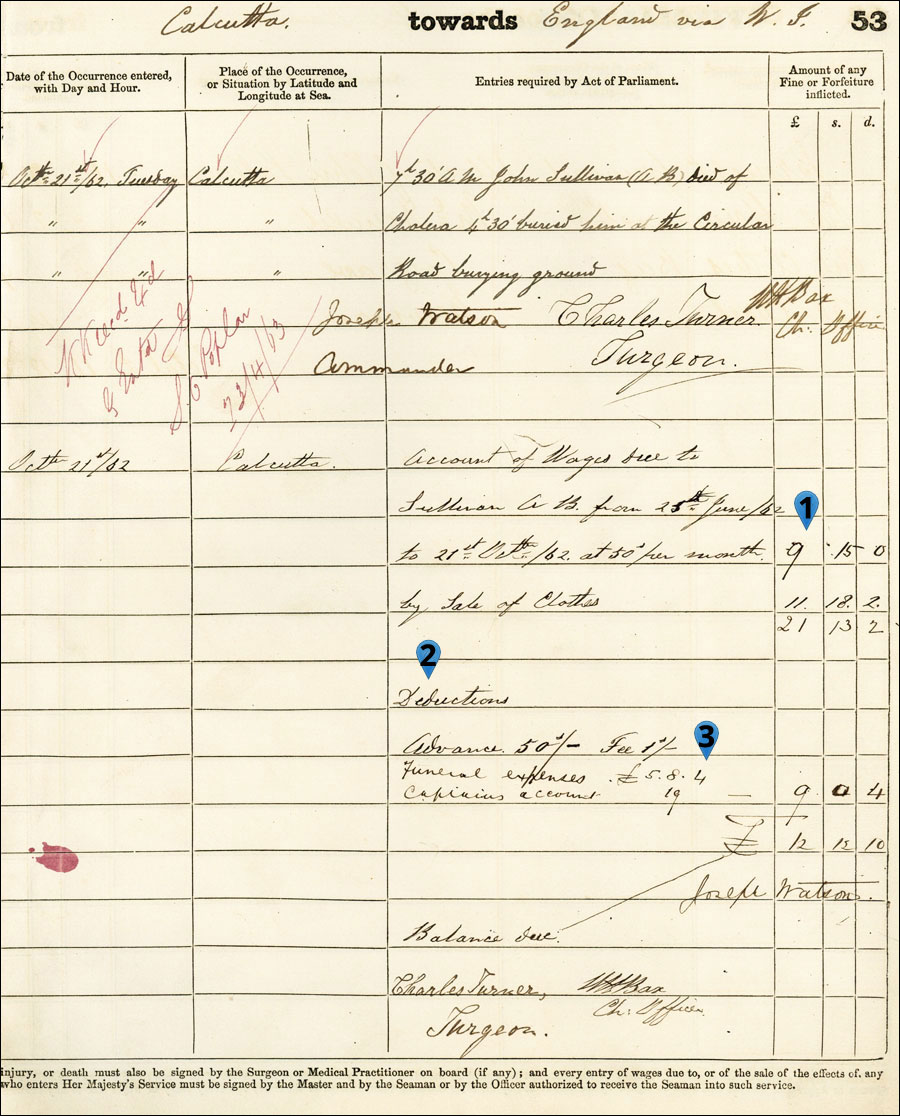
The majority of the currency you will see in this website is British sterling. Before 1971, when a decimal system similar to American currency was adopted, the British used a system now called "pre-decimal" where the pound (£) was broken down into shillings (s.) and pence (d.) rather than just pence, as it is today. This means that the wages and other monetary expenses you see in the Crew Agreements are entered in three columns rather than as numbers separated by a decimal.
The pound was worth 20 shillings, and 1 shilling was worth 12 pence. Therefore there were 240 pence to the pound. These are the three denominations used in the Crew Agreements.
The British Empire dominated the world economy in the late nineteenth century and the supremacy of the British pound reflected this. When seafarers signed a Crew Agreement in foreign ports or took liberty money or advances, they were more often given British pounds rather than the local currency (or at least they recorded the wages in British pounds).
| Did you know? |
|
The £ sign is a stylised derivative of the letter "L" from the Latin word libra which was the ancient Roman word for scales. The origins of the shilling and pence abbreviations are also based on Latin words. The symbol for shilling (s.) is derived from the Latin word solidus while the symbol for pence (d.) comes from denarius. Both are words for Roman coins |
Converting historical monetary values to a modern worth is an extremely complicated business. Luckily, the historians at Measuring Worth have created a special calculator which gives an idea of the purchasing power of your ancestor's wages.
While most modern currencies, including modern British pounds, are written in a decimal system (e.g. £2.00), most of the currency in the Crew Agreements is written in a pre-decimal format (e.g. £2 5s. 7d.). Most of the Crew Agreement forms were designed to accommodate this system. For example, the Official Log Book's pages were lined on the right-side of the page with three columns especially for recording and calculating wages or other monetary transactions. These columns are always headed by the £, s., and d. so it is usually easy to figure out which is which. Logically, the columns decrease in value as they move left to right.
When writing independently of the columns, however, masters had different strategies for indicating the denomination of the money they were writing about. For example, they very seldom wrote out 2 pounds, 5 shillings and 7 pence as £2 5s. 7d.. They were more likely to write £2 5/7 . The "/" is not actually a dash or a fraction symbol but is rather an extremely stylised "s" representing the abbreviation for shilling (see Reading the Handwriting for information on the stylised "s"). Masters also used decimals to write out monetary values, but using two decimals instead of one: £2.5.7
John Sullivan's Account of Wages is a good place to see different ways of writing out money. Sullivan died of cholera in Calcutta in 1863 while employed as an AB aboard the Clarence (ON 20848, 1863). Here the master, Joseph Watson, is working out how much the ship owes Sullivan (wages) and how much Sullivan owes the ship (deductions). Sullivan's Account of Wages is a good example because it shows all three of the styles of writing out pre-decimal currency already outlined above.