| An Introduction to Seafarers' Inventories |
| The Anatomy of an Inventory |
| A Sailor's Kit |
| Dead Men Do Tell Tales Selected Sources |
This day Fred Brown Departed this Life ... Buried him at 8.30 P M. He had no clothes [but] what he had on him. —Official Log of the Sir Henry Lawrence, 1866.
At 6 pm on Christmas Day, 1866, a 32-year-old Norwegian man named Frederick Brown succumbed to dysentery, a disease which he had contracted during the time the Sir Henry Lawrence was in Calcutta. When he died, his shipmates sewed his body in canvas and buried him after a brief two and a half hours, likely because he died in the heat of the Indian Ocean, only 6o degrees south of the equator. Frederick died with no possessions and was in fact in debt to the ship, having taken an advance of his £2 10s wages when he joined the Sir Henry Lawrence in November.
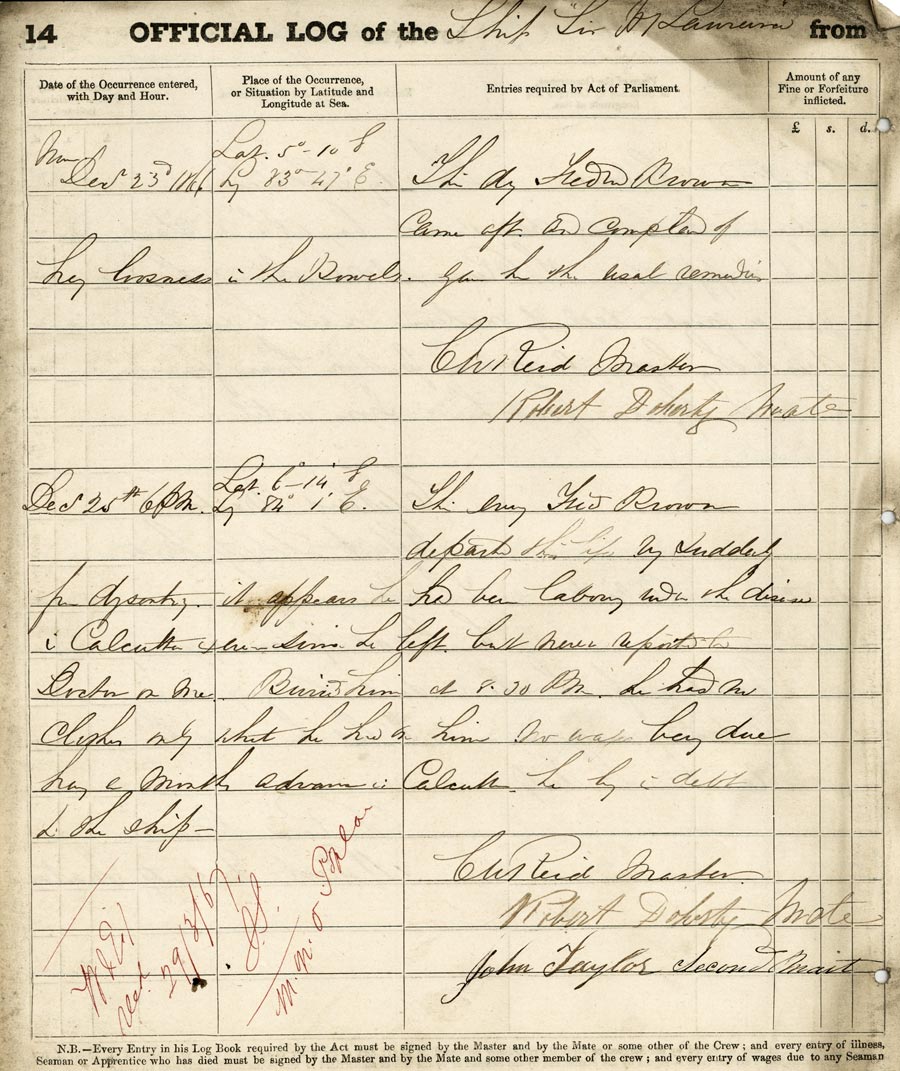
December 23, 1866: This day Frederick Brown Came aft and Complained of having looseness in the bowels. Gave him the usual remedies.
December 25, 1866: This day Fred Brown departed this life dying suddenly from dysentery. It appears he had been labouring with the disease in Calcutta and since he left, but never reported to Doctor or me. Buried him at 8.30 PM. He has no clothes but what he had on him. No wages being due having his month advance in Calcutta, he being in debt to the ship.
Frederick's lack of possessions is actually quite exceptional. Most men carried with them a basic kit of clothing, as well as items specific to their employment, such as oilskin coats or sailmaking palms. Frederick, however, died with no further material wealth than the clothes in which he was buried.
The following discussion of seafarer's inventories draws heavily upon the Crew Agreements between the years of 1863, when the Maritime History Archive's collection starts, and 1874, when the Board of Trade began to destroy the logbooks which most commonly contain detailed inventories. The destruction of logbooks makes it very difficult to find inventories after this period, though they do exist. See A Sailor's Kit: Beyond 1880 for further information on inventories outside of the 1860-1880 period.
Frederick was only one of many men who died at sea in the British Merchant Marine. When these men passed, whether by disease, drowning, or accident, the master of their ship was required by the Merchant Shipping Act to take possession of the deceased's wages and effects, and was allowed to liquidate the effects into cash if the master chose to conduct an auction for that purpose (Lees, 82). Then the wages, and the profits from the sale or the effects of the deceased seafarer, were either left with a British consul in a foreign country or with a superintendent at the port of discharge in the United Kingdom. This system existed to pass the deceased seaman's possessions and/or wages to his next of kin.
Generally, this system ensured that when a merchant seafarer died, at least a discussion of his material worth was recorded in the logbook. This ranges from a full record of the death, including an inventory and a breakdown of wages and deductions, to a brief entry stating cause of death and nothing more. The majority of inventories were left by able-bodied seamen, the most common seafaring position and the one which involved the most risk, but a ship was generally a risky workplace where anyone could drown or contract disease. So the cross-section of inventories is quite broad.
Passenger ships at times also employed stewardesses, so there is the potential for inventories of female employees. Unfortunately, so far only three deceased stewardesses have been found and since their husbands were also working on the same ships, their possessions were passed directly to their spouses instead of appearing as inventories in the logbook.
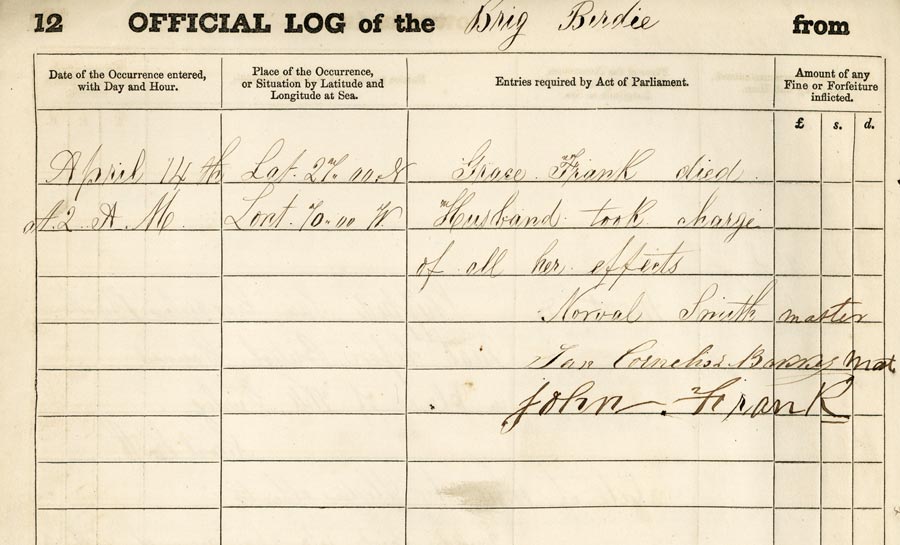
Every master of a ship, for which an official log-book is hereby required, must make, or cause to be made therein, entries of the following matters :— (12.) The sale of the effects of any seaman or apprentice who dies during the voyage, including a statement of each article sold, and the sum received for it. —Lees' The Merchant Shipping Acts, (1867).
The logbook was required for recording many things that were not elaborated in the Crew Agreement, and recording inventories was just one of the events which ship masters were supposed to enter into its pages. The logbook, then, can contain a wealth of information depending both on events that happened during the voyage and the willingness of the master to actually enter information. If the voyage was not particularly eventful rather little may be reported in the log. A fluent master and an eventful voyage are the circumstances which produce valuable and informative logs.
Where do you find inventories in a logbook?
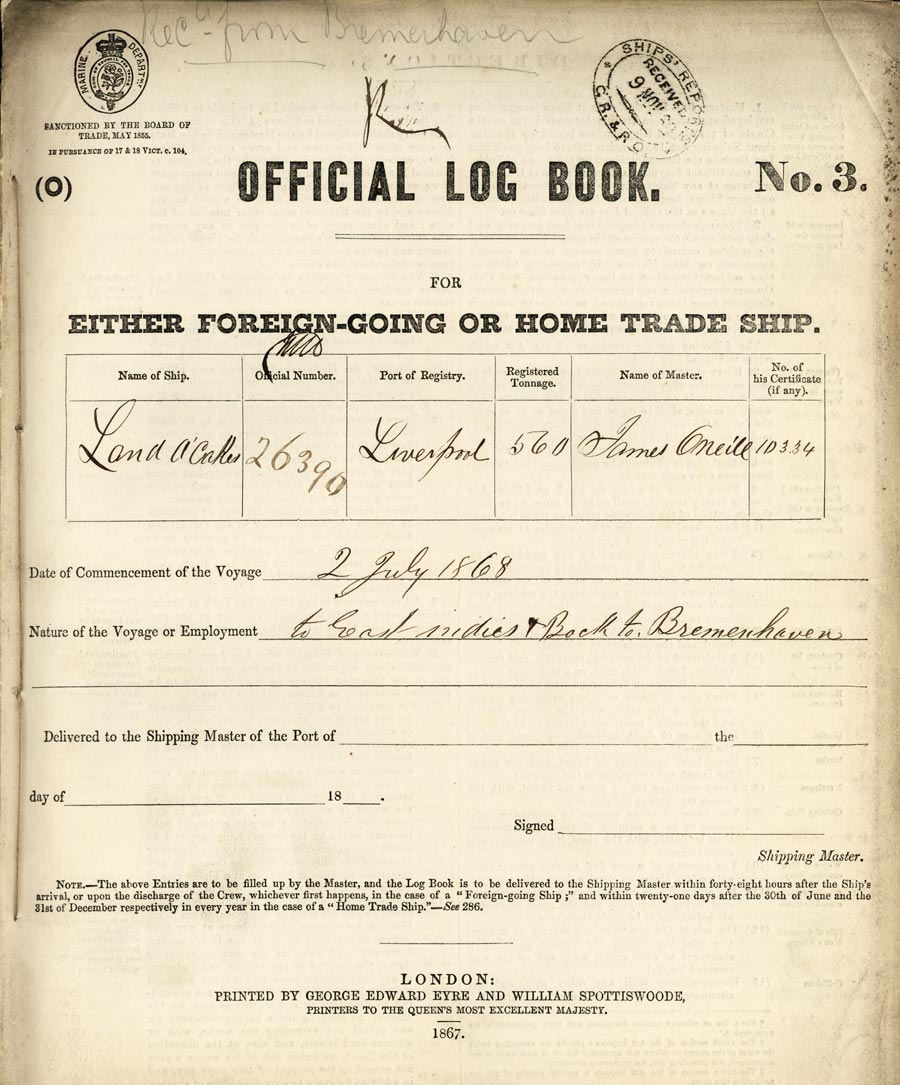
There are five sections to a log book. The first is the front page. This page contains information about the ship, including name, official number, tonnage, voyage information and the name of the master. The stamps of the Register General's Office also appear here.
The next section include pages 2 and 3, which are two printed pages of Instructions to Masters on regulations and fines which pertain to the information they have or should have included in the logbook. Thirdly, there is a page entitled an Index to Entries in the Official Log Book [see image below] which is a column of the information which the master is supposed to be recording. Next to these, the master records where this information is found in the log.
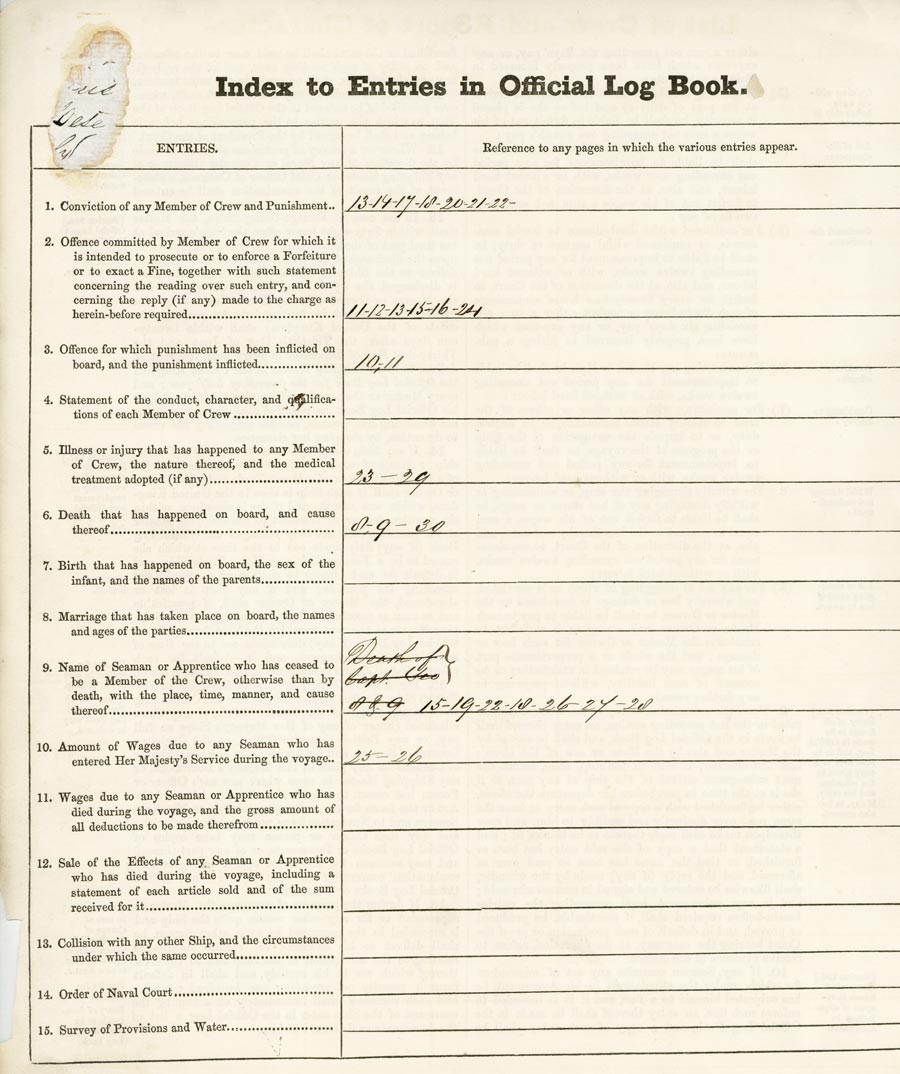
Page numbers of inventories could be recorded under:
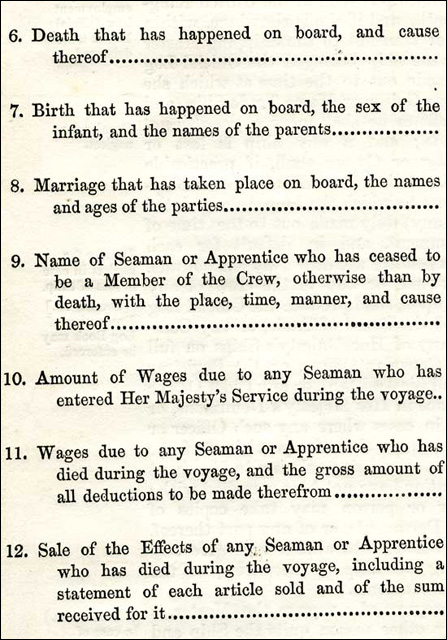
Generally, even though 12 is the most appropriate row for inventories, you will most likely find inventories attached to the record of death, which is number 6. The recording of wages and items often occurs at the same time and so the master may record both under number 11.
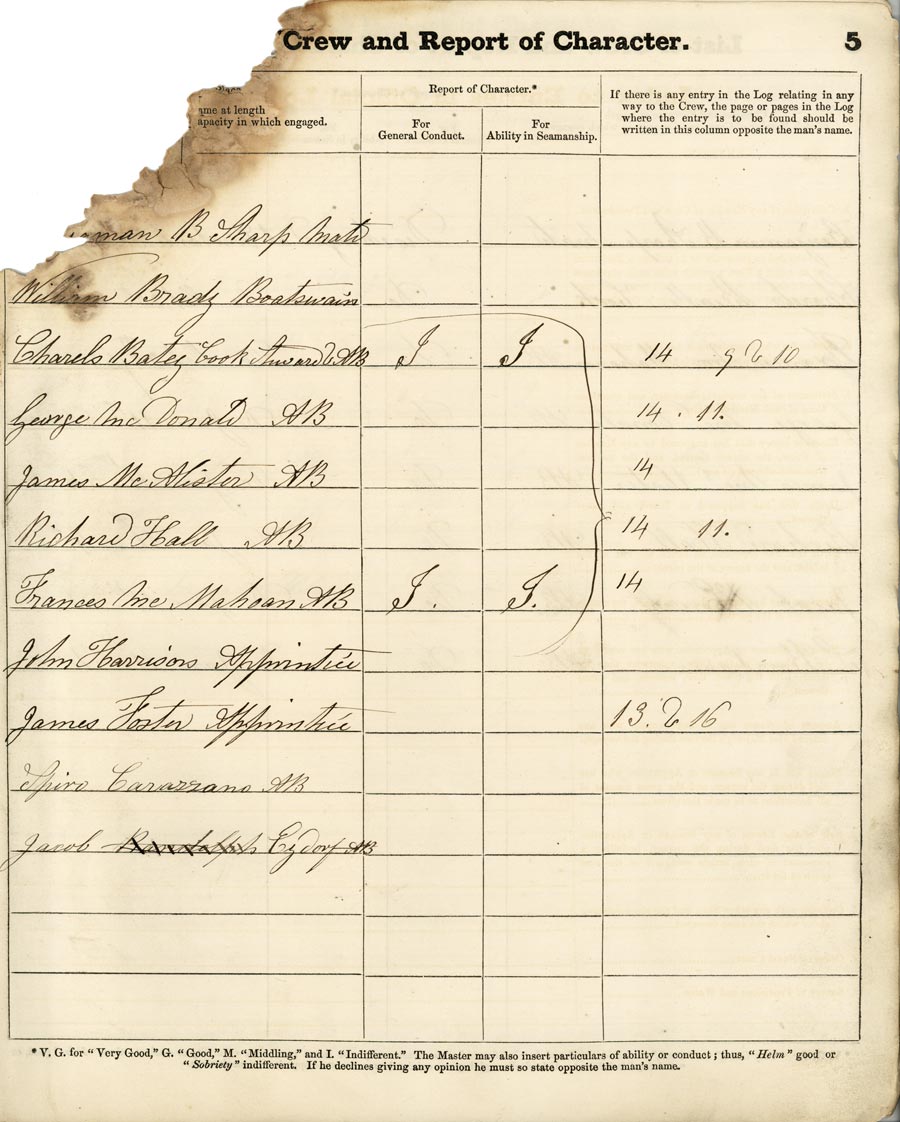
The fourth section, List of Crew and Report of Character, takes up as many pages as there are crewmembers. This section records the performance of the crew with designations Very Good, Good or Decline to Report. What is important here, however, is that sometimes the master records where information on particular crewmembers appears in the log. This can be helpful if you are looking for a particular relative or if you have discovered a death in the crew agreement.
Finally, the most important section of the log is the logbook proper. This is the section of the log where the information about the voyage has hopefully been recorded. If the master has not indicated where a death or an inventory can be found in the log, you will have to read the logbook entries until you find it.
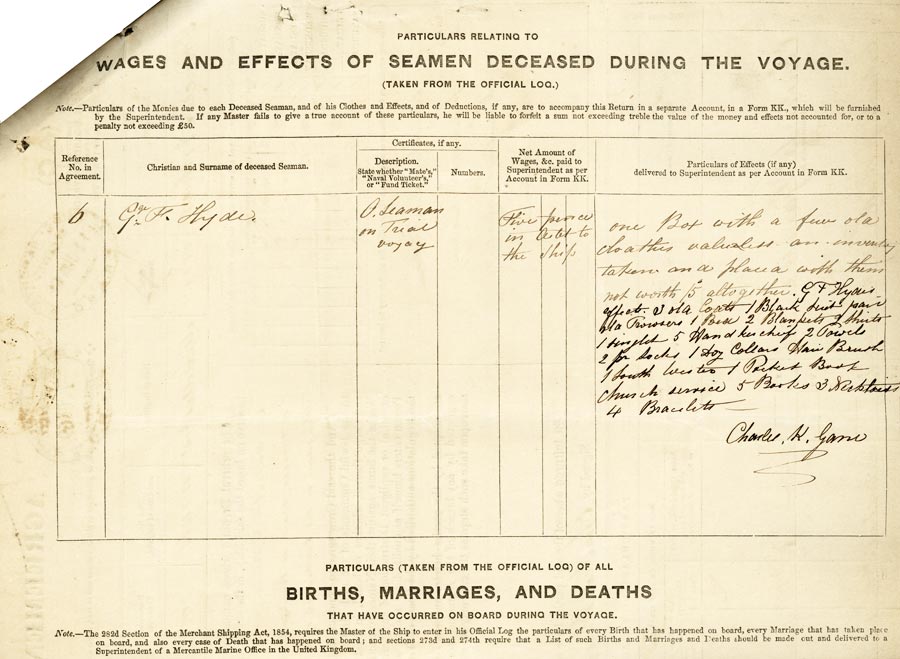
Inventories do not, as a rule, always appear in the logbook. More rarely, they are also present in the Crew Agreement under the heading Particulars Relating to Wages and Effects of Seamen and Apprentices Deceased During the Voyage. However, it is important to note that the information written in this section has been transferred from the logbook and because of this it is either more brief or an exact copy of what appears in the log. This section can be useful if the logbook has not survived, but do not depend upon finding information in this section.
There are generally two types of inventories which may appear in a log. First, there is the auction-inventory, which lists the items and gives the amount for which they were sold (which was required by the Merchant Shipping Act). These lists sometimes say who purchased the items and if the inventory is categorized by buyer rather than item. These are a bit harder to understand as a list, but they are invaluable as a tool to measure not just the dead seaman's material wealth, but also the financial means of his fellow crewmembers. Margaret Creighton also suggests that when purchasing the items of their deceased workmates, sailors tended to pay more than the items were worth, aware that these proceeds would be going to the man's family (137). Thus, when calculating the "worth" of the auction-inventory it is important to remember that there are symbolic values being attached to these items as well as monetary ones.
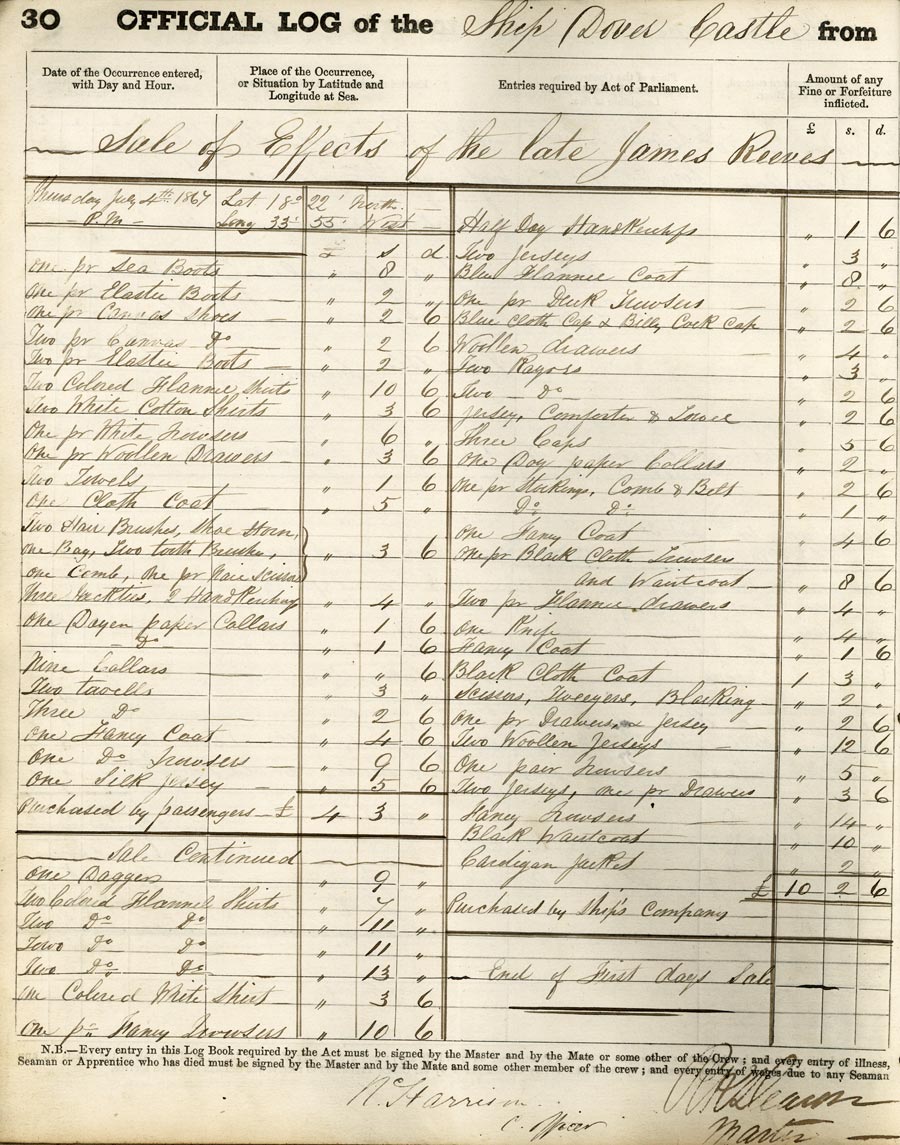
The second type of inventory is simply a list of items, or a list-inventory. Sometimes these are coupled with summary value of the whole inventory but not of individual items, so it is difficult to use these inventories as a breakdown of monetary or symbolic value. These inventories are either extremely long, or the reverse, extremely short. The longest are often the inventories of masters and these are list-inventories because their possessions were often returned to their families. The crew might have been hesitant, or simply financially unable, to make purchases from their late master's possessions.
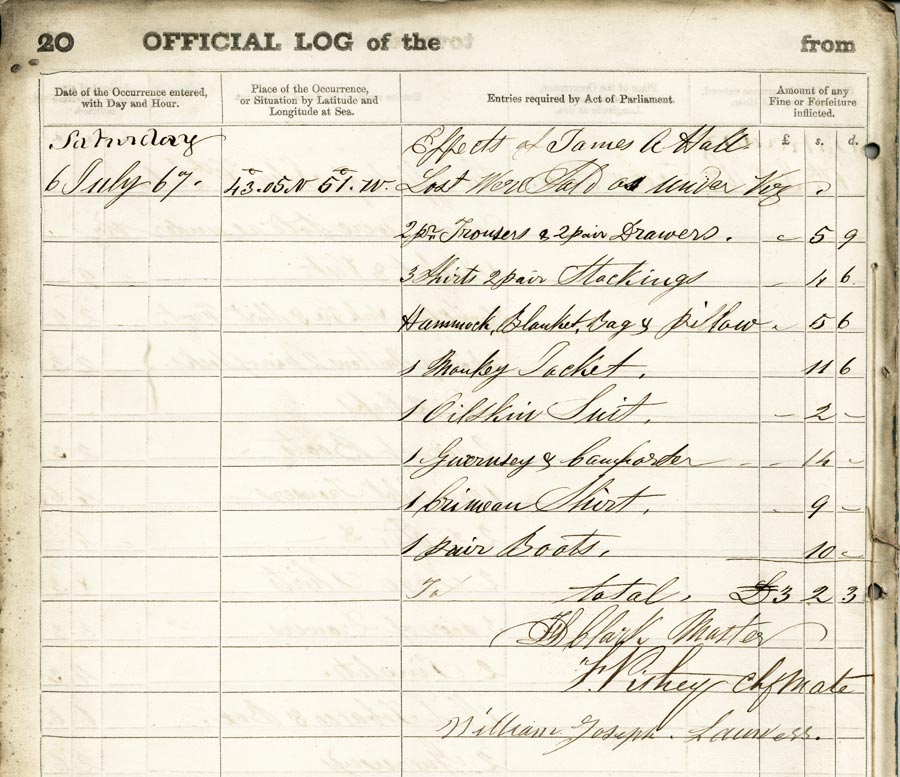
Generally, you will find inventories without looking for them. They appear as lists of items close to a description of the cause of death and a summary of wages and deductions. On occasion there may be little information, and the Register General of Seamen may chastise the master for it. More often, inventories contain a wealth of information on what a seafarer's material world was like. It may not be your ancestor, but a glance at the items could be a clue to what your relative was carrying with them, what they were purchasing from the ship, the advances in wages they may have taken. Maybe there is a mention of an item your ancestor purchased from the deceased's possessions.
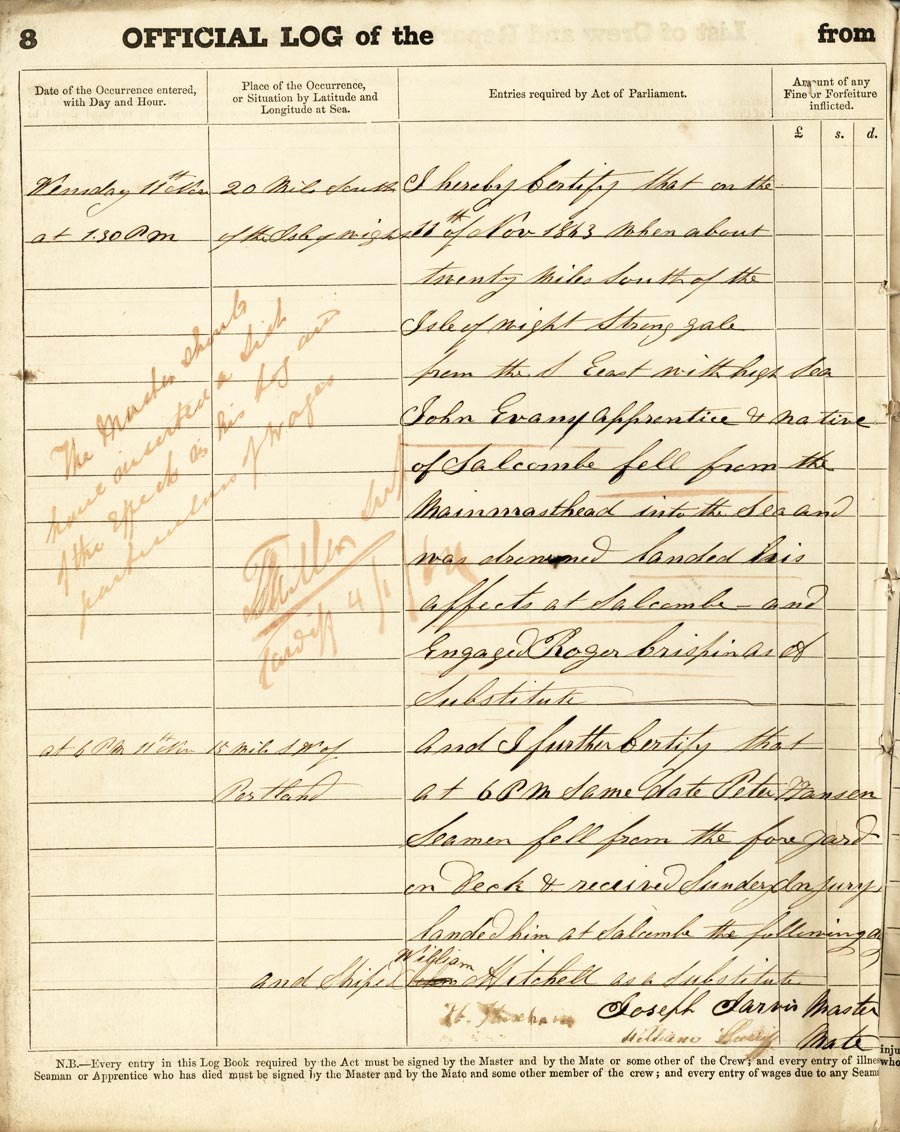
This is a good question, one that this entire website hopes to answer. Why should you go beyond the trouble of finding the name of your ancestor in the crew agreement? The "More than a List of Crew" team believes that you are searching for more than just a name. We believe you want to know not just that your great-great grandfather was a merchant seaman, but also what he did, how much he was paid, what his working conditions were like, and, most importantly for this section, what he wore and owned. Few other occupations outside merchant seafaring are documented with the kind of information that was recorded in the Crew Agreements and Logbooks, now held by the MHA. This website helps users make sense of that information in a way that may not have been possible before.
What, then, can inventories tell you about your seafaring ancestor? There are two ways of answering this question. Cumulative research into inventories shows what you might expect your ancestor to own even if he did not personally leave an inventory. The inventory also tells us specifically about the man who owned the items. John Spearay, AB aboard the Dover Castle, owned a copy of A History of England when he died in 1867, some serious reading indeed.
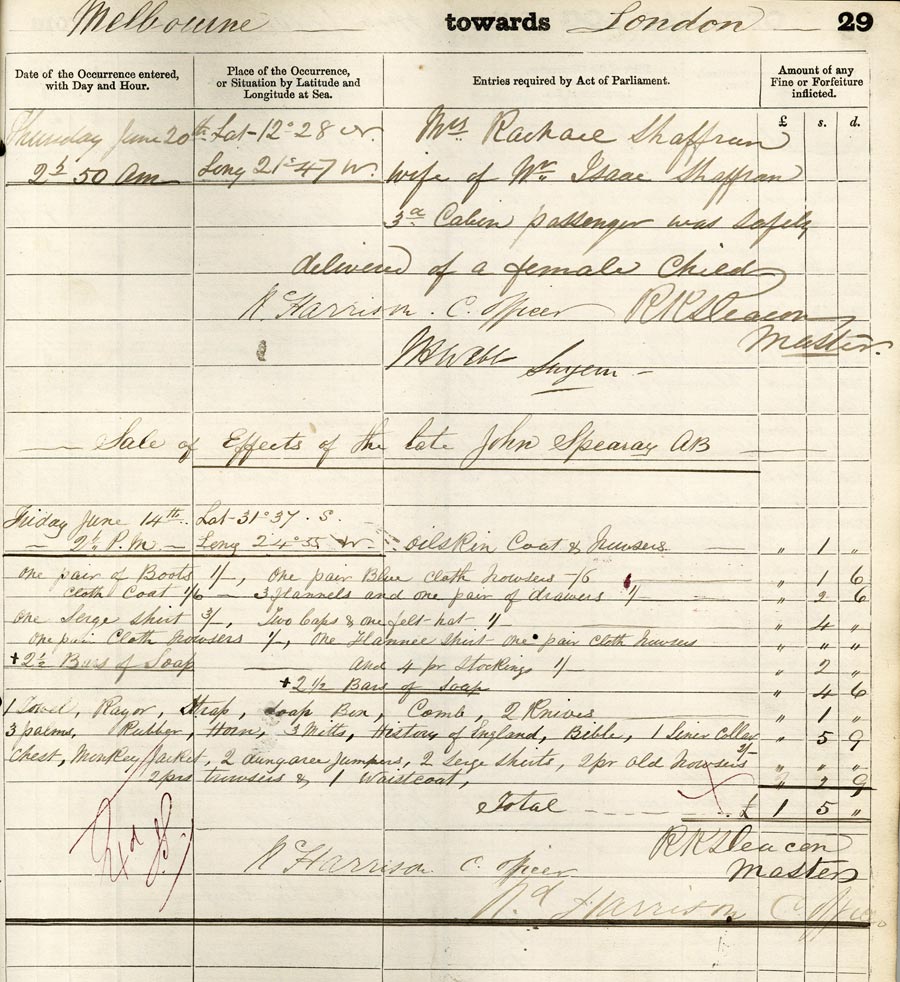
He might have been one of many workingmen committed to improving his education through self-instruction. Alfred Etherington, an AB from the Paris City, died in 1934 with 27 silk handkerchiefs in his possession. This could indicate that he put considerable stock in his personal appearance, but it could also mean that he was bringing them home from Shanghai as gifts or even to sell for some additional income.
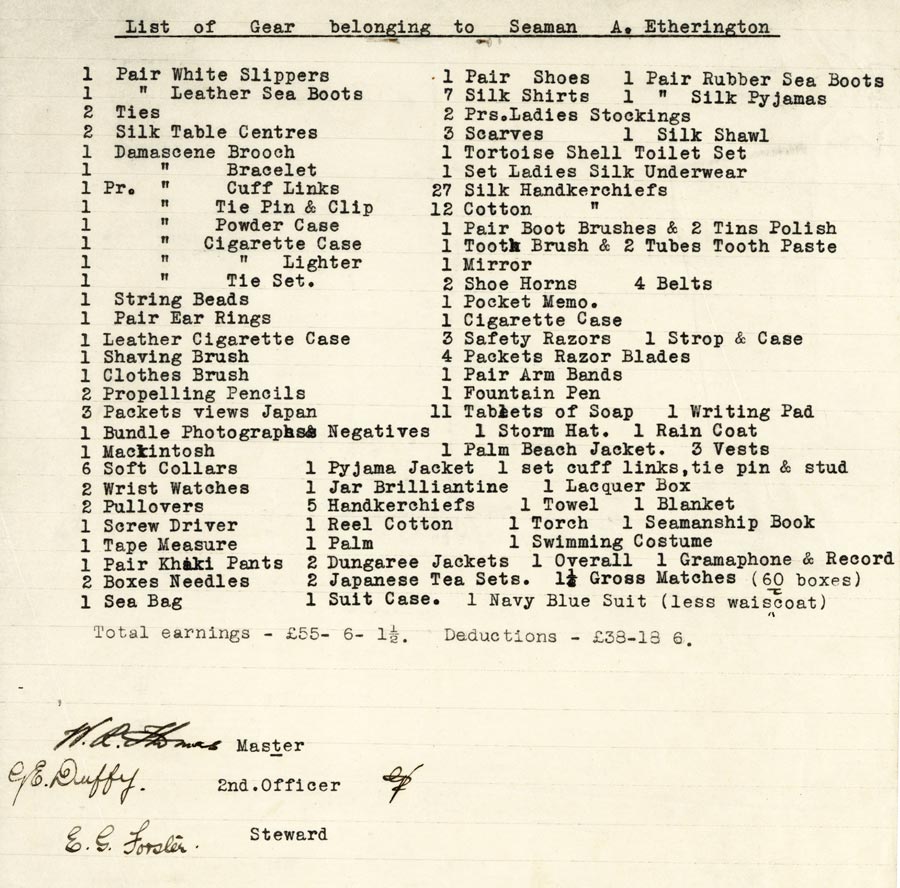
Possessions were not simply things you owned or wore, they were also items which could be readily liquidated into cash when times were tough. Because of the mass of information contained in the MHA, the material wealth of these men is much better recorded than for most other contemporary workers.
