| An Introduction to Seafarers' Inventories |
| The Anatomy of an Inventory |
| A Sailor's Kit |
| Dead Men Do Tell Tales Selected Sources |
At 3 P. M. in stowing the Main Sail Francis Harvey A. B. fell overboard and was drowned.
—The logbook of the Alipore (ON 12547), 1863
So begins the first line of the entry of page 19 of the Alipore's logbook (see below)1, written at 3 pm on 27 March 1863, not far from the Frisian Islands. The master, Melch Cowan, continued by assuring the Register General of Seamen that he had tried his best to rescue Harvey,
The Life buoy was immidiatly [sic] thrown to him, + the Life boat lowered - Soon after leaving the Ship the Life buoy was seen + picked up but unfortionetly [sic] the man was mifsing + after pulling for some time, a signal was made for the Ship to return.
The master then listed the effects of the deceased,
and calculated the balance of wages,
Wages by the run from
These are the three elements of a usual inventory. Harvey is a very good example because its small size means that the entire record appears on only one page. Some inventories appear over several pages and they are not always together. Finding, processing and recording inventories are the first big hurdle when dealing with these records.
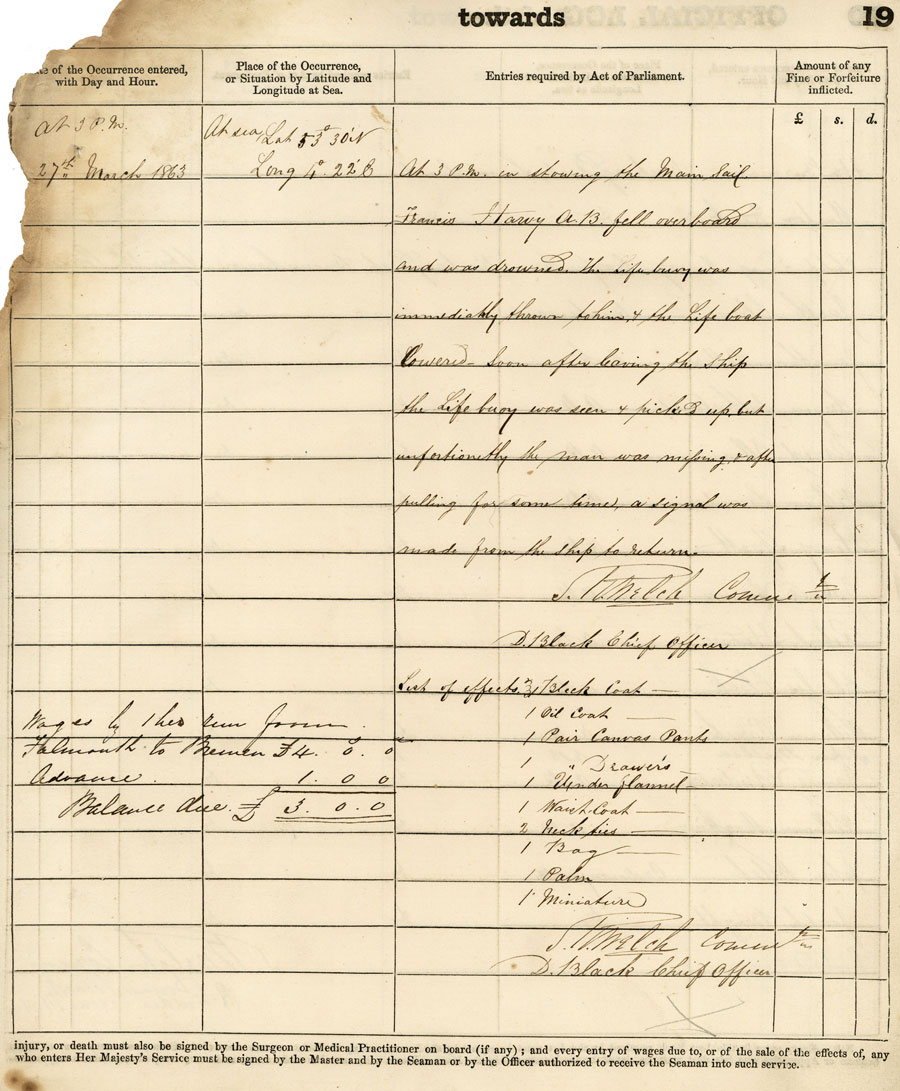
Inventories appear in various orders but generally the information is presented as above, with a section explaining the cause of death, another section listing the inventory and a third discussing wages and deductions. The list and wages sections are usually together but it may take some hunting in the rest of the logbook to find the cause of death.
Space
When looking at inventories there are a few things to keep in mind. First of all, Judith Fingard suggests that most inventories would represent the entire material possessions of these seafarers (Fingard 1982, 79). This is important to consider because seamen were allotted at least 72 cubic feet of space and 12 square feet of floor space according to the Merchant Shipping Acts of 1854 and 1894. That space was all they had to put their things, so obviously they could only bring so much, generally what could be stored in a sea chest or clothes bag. So sailors were limited by both what they could bring with them on a voyage and what they could fit in their berths.
Provided Items
Certain items are consistently missing in inventories which means that they were expected to be provided by the ship. Cutlery and dishware are generally absent from inventories, though the occasional enamel tin or iron cups do appear.
Luxury Items
Bedding is also conspicuously absent from inventories. John Whidden found to his youthful surprise that bedding in the ship's forecastle was considered quite the luxury, when in 1845 on his first voyage a fellow sailor "mounted my sea-chest and glance into my berth. [He] exclaimed with withering sarcasm, 'Well I'm blessed, Joe' (only he did not say "blessed"), 'if the beggar ain't got sheets!'" (Whiddon 1925, 9). The 13 year-old Whidden promptly stripped his bed and went without for the rest of the trip. Bedding more often appears in the inventories of stewards, officers and masters than regular crewmembers.
Buried with the Deceased
Finally, certain important items of clothing can be missing. Harvey, for example, has no shirts. This is because concessions must be made for clothing items which the seafarer was wearing when he either died or was buried. In Harvey's case, we can assume he died in his only shirt. When the seafarer died aboard the ship and was buried at sea, it must be remembered that he was likely buried in his best suit of clothes and so these items would not appear in the inventory. Wedding bands and other jewelry, such as crucifixes would also have stayed with the body.
