| Sailortowns and Docklands |
| Where was Sailortown? |
| What was Sailortown? |
| What happened in Sailortown? |
| Sailortown from above |
| No more Sailortown? |
| Sailortown Selected Sources |
There was a lot of concern about sailortown. In the late-nineteenth century, people were writing about it around the world wherever Britain's large merchant marine made port. One of the most interesting books discussing a particular sailortown was Reverend James Fell's book, British Merchant Seamen in San Francisco. In it, Fell discussed how giving seafarers lump sum wages at the end of the voyage predisposed them to be exploited by crimps and other "friends" of seafarers. He portrayed the wage system as being the chief evil, forcing otherwise good sailors into poverty and vice. Fell does not address why seafarers never seemed to learn their lesson and avoid sailortown.
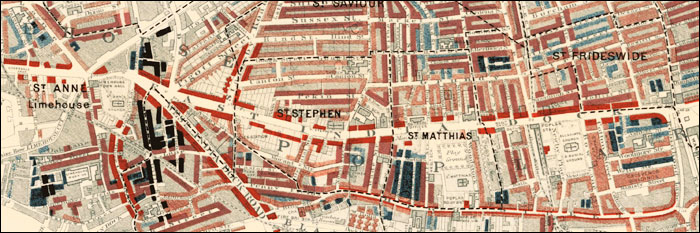

Middle-class residents saw sailortown as a dirty series of alleys and courts that attracted poverty and vice through taverns, brothels, gambling halls, even opium dens. This type of poverty was very visible. Before the 1950s and the popularity of suburbs, the differing classes of people lived surprisingly close together, and even when their homes were separated, middle-class men involved in shipping passed through the sailortowns to visit their wharves and warehouses. The world of sailortown seemed to be the very opposite of their own. In order to survive, women had to work by doing sweated labour, going to factories, taking in washing or becoming prostitutes. Men went to sea or they worked at casual labour on the docks. Seafaring caused the breadwinner of the family to be absent for large periods of time, where the family had to subsist on half-pay. Casual dock work meant that there was no guarantee of work from day to day, or even from morning to afternoon. Unable to earn regular wages, thereby providing for their wives and children, men associated with sailortown and docklands did not fulfill the responsibilities of a male breadwinner which was a cornerstone of middle-class respectability.
Men like Rev. James Fell still respected seafarers. His focus on crimps, prostitutes, and other supposedly predatory people who operated in and around sailortown and docklands, essentially shifted the blame away from victimised seafarers onto those who preyed on them. This, however, diminished an understanding of free will and choice on the part of seafarers. Sailortown was far more complicated than most authors credit it. Similarly the motivations of the seafarers and other working-class people within sailortown borders were far more complex than simply getting drunk at a tavern and starting a brawl (Fingard 1982; Burton 1999).