| Introduction |
|||||||||||
|
|
||||||||||
William Cram, an AB seaman on steam colliers, worked from South Shields, Tyneside in north east England in the early 20th century.
Cram is our featured seafarer on the Brio, the sample home trade Agreement. You can follow an explanation of the information recorded about Cram by clicking on the tabs on that Agreement. We have gathered more information about Cram's career over four years of seafaring (1908-1911). Here we tell you about the Agreements and other primary documents we used for research on Cram, the crews he sailed with, and the vessels on which he worked.
The team's first observation of Cram was in a 1911 census record.
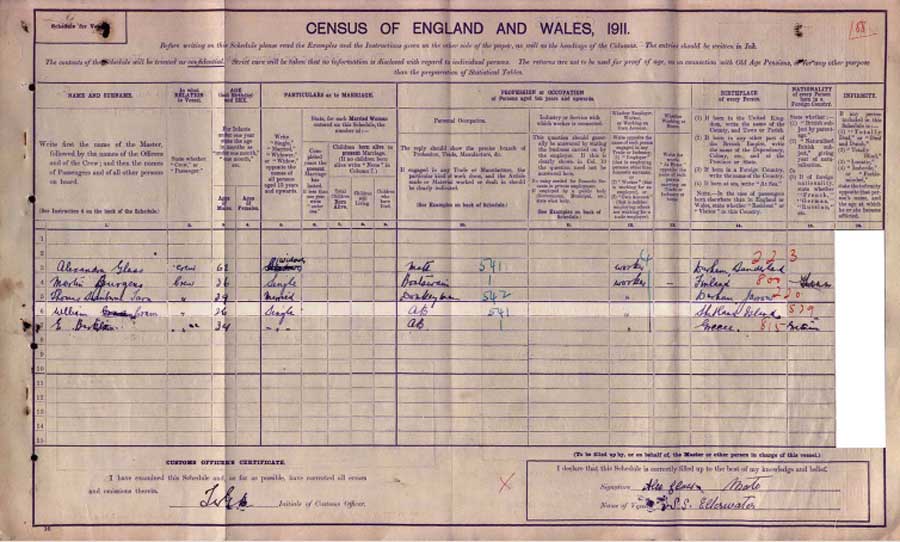
| Alexander Glass | Crew | 62 | Widow | Mate 541 | Worker | Durham, Sunderland | |
| Martin Burgess | " | 36 | Single | Boatswain 1 | " | - | Finland |
| Thomas Swinburne Tarn | " | 39 | Married | Donkeyman 542 | " | Durham, Jarrow | |
| William Cram | " | 26 | Single | AB [Able seaman] 541 | " | Shetland Islands | |
| E. Bert??? | " | 34 | " | AB 1 | " | Greece |
Five crew were aboard the Elterwater when the census was taken: the mate, boatswain, donkeyman, and two AB seamen, Cram being one of those seamen. He was listed fourth on the form. In this case, all on board seem to be regular seafarers, though temporary ship watchers sometimes appear in vessel enumeration schedules. There are cases, too, which suggest seafarers of no fixed abode made their homes on ships in port. See the article "A Floating Population" for further details of vessel enumeration.
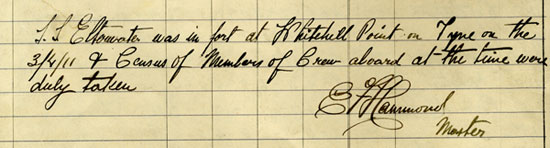
The logbook of the Elterwater indicates the vessel was at Whitehill Quay at the time of the census. This mooring place on the Tyne suggests the vessel was alongside one of the five staithes where coal could be delivered to vessels at the rate of 500-700 tons per hour (Elterwater MHA Crew Agreement, Official Number 125431, 1911, " Particulars of Wet Docks", Lloyd's Register of Shipping, 1908-9, Appendix, p. 579).
Cram's fellow ship-watcher at the time of the census was a 39 year-old donkeyman Thomas Swinburne Tarn. He was a married man, the only one onboard, and though he probably he had a home to go to, his services would be most useful during loading because his job as the ship's donkeyman made him responsible for powered equipment on board the Elterwater.
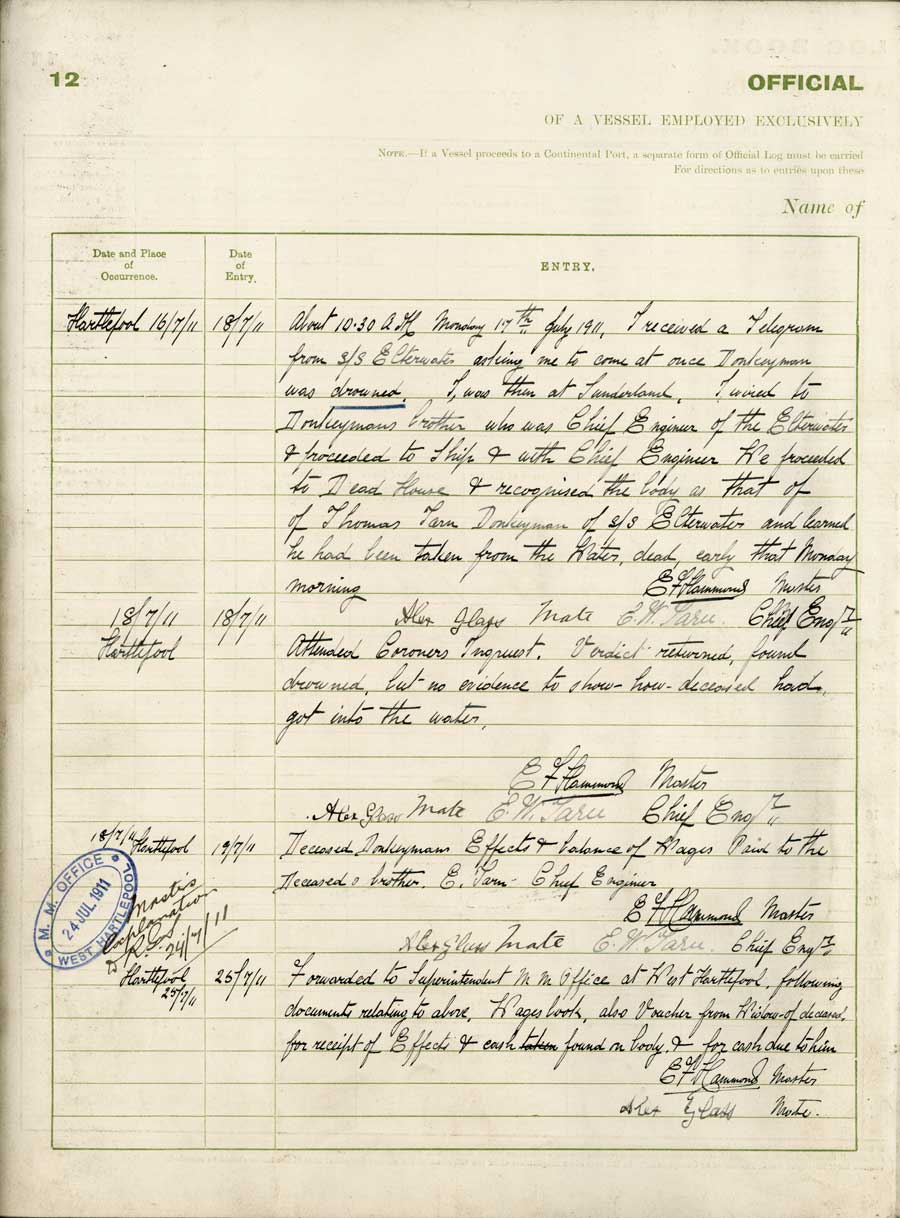
He stayed with the Elterwater into the subsequent half-year. But his death by drowning in Victoria Dock, Hartlepool was the subject of the log entry from the Elterwater that is reproduced here. From this it becomes clear that the Elterwater's Chief Engineer was Thomas Tarn's younger brother.