| Martin and Jessop: Introduction |
| William Martin, Ship's Steward |
| Violet Jessop, Ship's Stewardess |
| Martin and Jessop Selected Sources |
Violet Jessop was born of English parents in Buenos Aires. By the time she went to sea her birth family lived in London and she stayed with them when she was on shore. She is reminiscing later in life. In fact, she wrote her memoirs and these were published belatedly, after her death.
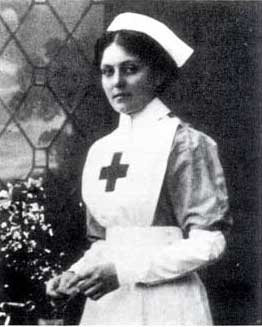
Listen to the story of a Stewardess
I doubt that I would have thought of going to sea, except that mother had been a stewardess, and I’m not sure what put it into her head to take up the occupation. I’d like to call it a profession, but I’d be misleading you if I suggested that either in her day, or even at the beginning of mine, women’s employment at sea was treated with the seriousness that would have meant it being seen as a profession. It turned out to be a life-long career for me. I was serious about, despite the occasions when I might have said “enough grief” and given up, for I was aboard the hospital ship Britannic when she struck a mine in 1916 and before that, well yes, I was a Titanic stewardess, just one of twenty to have signed onto that unfortunate vessel.
| Stewardesses serving aboard RMS Titanic April 10-15 1912, (From Titanic Voices Crew Lists). |
| Name | Age | Place of Birth | Given Address | |
| 1 | Bennett, Mabel | 30 | Hants | 22 Cranbury Avenue, Southampton |
| 2 | Bliss, Emma | 40 | Rolle, Switzerland | 56 Upper Park Road, New Southgate, Middlesex & 57 Church Road, Woolston, Southampton |
| 3 | Caton (Miss) | 50 | London | 50 Highbury Hill, London |
| 4 | Gold, Kate | 40 | Woolwich | Glenthorn, Bassett, Southampton |
| 5 | Gregson, Mary | 40 | Liverpool | 28 Lawland Road |
| 6 | Jessop, Violet Constance | 24 | Buenos Ayres | 21 Shirley Road, Bedford Park, London |
| 7 | Lavington, B. | 29 | Wells | Manor Farm, Headbourne Worthy, Winchester |
| 8 | Leather, Elizabeth W. | 41 | Liverpool | 38 Park Street, Port Sunlight |
| 9 | Marsden, Evelyn | 27 | Hants | 7 West Marlands Terrace, Southampton |
| 10 | Martin, Annie | 33 | Guernsey | Posbrooke Road, Milton, Portsmouth |
| 11 | McClaren, H. (Mrs) | 40 | Liverpool | 9 Shirley Road, Shirley, Southampton |
| 12 | Prichard, A. | 33 | London | 9 Roselyn Road, East Ham, London |
| 13 | Roberts, M.K. | 30 | Liverpool | 9 Chestnut Grove, Nottingham |
| 14 | Robinson, Annie | 40 | Bedford | 128 Shirley Road, Shirley, Southampton |
| 15 | Sloan, Mary J. (Mrs J) | 28 | Belfast | 1 Kesland Crescent, Belfast |
| 16 | Slocombe, Maude | 30 | London | 8 Leopold Terrace, Tottenham, London |
| 17 | Smith, Katherine E. | 42 | Gloucester | Balmoral, Cobbett Road, Bitterne Park, Southampton |
| 18 | Snape, Lucy Violet | 22 | Hants | Well Lane, Sandown |
| 19 | Stap, S.A. | 31 | At Sea | 41 Bidston Avenue, Birkenhead |
| 20 | Walsh, Katherine | 30 | Tipperary | 57 Church Road, Woolston, Southampton |
| Vessel: RMS Titanic ON 131428, 46328 Gross Tons Owner: White Star Line (Oceanic Steam Navigation Company) Voyage: Southampton (10/4/1912) - Cherbourg, France (10/4) - Queenstown, Ireland (11/4) - New York (intended) - Sank (15/4/1912) at 41°43'57" N, 49°56'49" W |
||||
The family travelled in my early years. In fact, the Jessops were settled in Argentina in 1887, the year I was born. But just a few years later mother was a widow and we uprooted, back to Britain. In Buenos Aires I spoke Spanish, and in my convent school I was taught French. Of course I didn’t know what was in store, but perhaps my being able to communicate in these languages impressed the personnel department at the office in London when I went enquiring about a job. It was the RMSP – the Royal Mail Steam Packet Company, and its vessels went to the West Indies, but mostly to South America. There were always some travelers aboard who didn’t speak a word of English.
I was rather young for the liner company, 21 at the time, and I know they hesitated: at least they kept me waiting a long while for an answer. You shouldn’t take youth and prettiness as any kind of advantage to a stewardess. In fact for my second interview I turned up in my dowdiest clothes to play down my attractions, or the distractions they were in the eyes of the company. It only put women on ships because of the female fare-paying passengers. But my pals were having difficulty getting into jobs as secretaries: even typists then were mostly men, and a ship certainly didn’t run like an office. In a small way I think we women at sea were pioneers.
We were different from mother’s generation. True, I went with her encouragement, though she needed me to provide the money for a young family. In her time most stewardesses were the widows of company men. They were women like Mrs. Brown, an RMSP employee in the 1880s. It’s possible she was still around when mother made her first voyage. Perhaps you can see what toll stewarding took on Mrs. Brown. Look at her anxious face and how uneasy she is with hands stilled by the photographer’s request for composure. He's taking too much of her time, and she’s likely listening for a call from the next passenger. I wonder how many of her thoughts were also with her children at home.
![Maria[?] Brown, Stewardess, c. 1880](../images/maria-brown-stewardess-1880.jpg "Maria[?] Brown, Stewardess, c. 1880")
Most of the stewardesses I knew made sure that families would have some benefit from their work aboard ship. They left a portion of their wages to be paid to them each month, whereas many of the men, including our fellow stewards, let earnings accumulate. It was important on these long trips that you saw to families having some benefit. This was less so when I moved to the North Atlantic passenger liners. On those vessels I was away for periods sometimes shorter than a month.
You want to know about my first voyage, and whether I remember “signing on”. Well yes, it was quite a special moment, strangely more so than when the ship pulled away from the quay for the first time. I recall the stewardesses would be chaperoned from their digs, and when we arrived at the Southampton mercantile marine office the crowd of men parted to let us through. We were treated with the utmost respect and courtesy. Signing on felt like joining a sea-going fraternity, though I must say we were never entirely “seamen”, even though our sex was irrelevant to the official definition. There were constant reminders that not only were we different from the male stewards aboard, but from the passengers too, even those travelling third class. My saving grace was making my own clothes because I could always pack my trunk with some of the latest fashions.
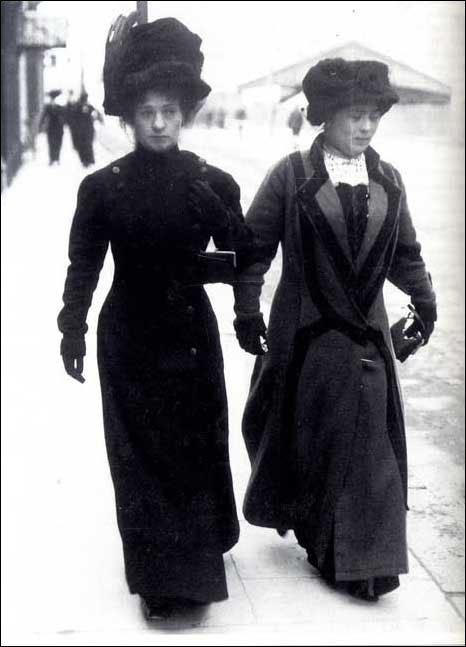
Then in a port overseas I’d make a point of having local guides take me to places where neither the travelers nor the crew would go. No one either knew or cared that I was a stewardess. Don’t mistake me, I had some fine relationships with stewards, but it was a great deal easier as I grew older and when age and experience made up for what stewardesses lacked in formal seniority.
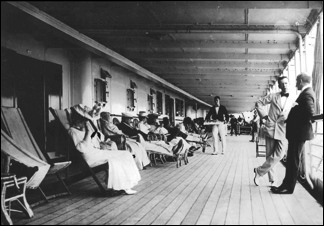
You referred to the “Ship’s Steward’s Guide”, and I think William Martin, the Canadian Pacific steward talked to you about some of his tasks as he recognized them in that book. Are you surprised that in over 200 pages there’s only one page given over to stewardesses? Does it mean we had anything less to do during the day? Not at all, we were always on call, though we had to be much less conspicuous in our work than our more numerous male colleagues. As I remember, Titanic and Olympic each had over four hundred steward and galley crew and while there were no designated female waiters, for example, stewardess had to wait on ladies who took their meals in their state-rooms.
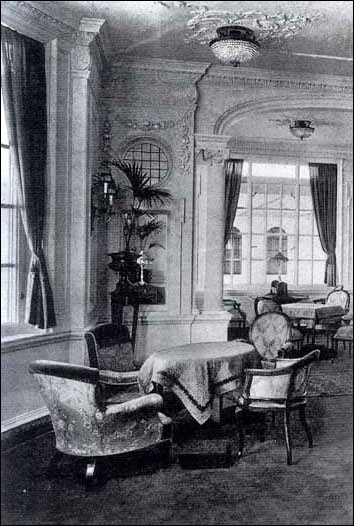
A formal career structure didn’t exist for us, so you can forget the idea that the Head Waiter or Chief Steward had female equivalents. We started out at a comparable rate of pay with the men, £2 a month, as I remember, but it never went anywhere. That’s why our tips were so important and, of course, one got better in determining what kind of service would bring those unwaged rewards. Yes, I did my job well, and three times I lived to tell a tale of an experience the like of which few women had. Going to sea left us stewardesses with quite a different view of the way the world worked for women.
References
Jessop, Violet, and John Maxtone-Graham. Titanic Survivor: The Memoirs of Violet Jessop, Stewardess. Stroud: Sutton, 1998.
Bond, Richard. The Ship's Steward's Handbook, A Complete Guide to the Victualling and Catering Departments on Board Ship. Glasgow: James Munro & Co., Ltd, 1918.
Hyslop, Donald, Alastair Forsyth, and Sheila Jemima. Titanic Voices: Memories from the Fateful Voyage. New York: St. Martin's Griffin, 1999.
