| Martin and Jessop: Introduction |
| William Martin, Ship's Steward |
| Violet Jessop, Ship's Stewardess |
| Martin and Jessop Selected Sources |
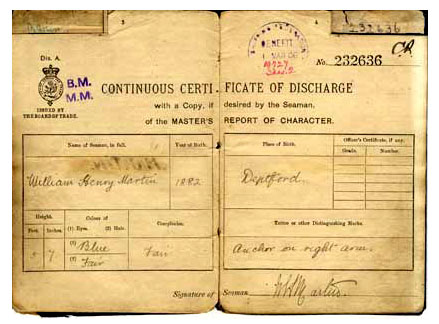
Martin was a steward (for some part of his career, a head waiter). We know a little of what he looked like from his discharge book. He went to sea first during the Boer War as naval recruit but spent most of his time on the Canadian Pacific Railway ships out of Liverpool and London. Deptford was the address he gave on shore. We meet him in later life reminiscing.
Listen to the story of a Steward.
So, you've looked at my Discharge Book?
Never once was that book stamped with anything less than a "very good" report. Excellent, eh? But I'd better not make too much of it, because neither was anyone else's: at least none of ‘em that I knew.
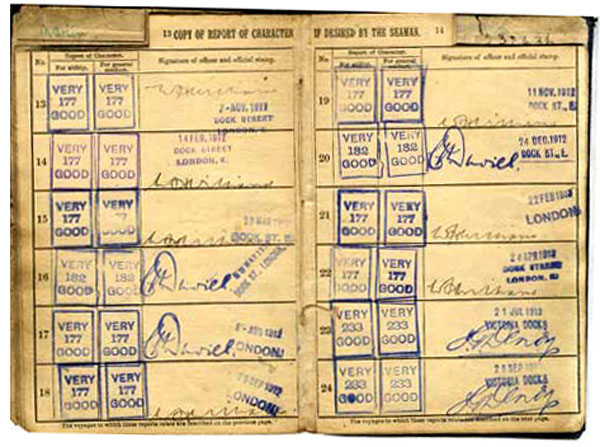
Coming away with a "Decline to Report" would have meant you had behaved pretty badly. It was a real black mark. You wouldn't have been able to go to another company and show it: no, your job would have gone.
It was called a Continuous Discharge Book and it replaced those single certificates we had before. Evidently the Board of Trade had been doing some thinking about how men "lost" them – losing them might be convenient, you understand – they realized you wouldn't be able to do that with a book. Men grumbled at the time, but I'm rather pleased to have mine. Now it's about all I have to remind me of my travels.
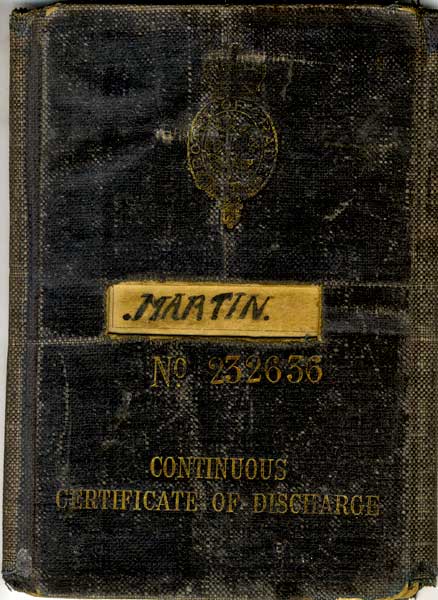
I mostly went with the Canadian Pacific,1 but if you're going to check it out in that Archive where you say you have my articles -- curious that, you being in Newfoundland -- if you look at them you'll see I had jobs with several of the North Atlantic companies out of Liverpool and London.
It wasn't easy changing companies. Each of them had different uniforms, and they had to be paid for from your own pocket. Some were elaborate, and none were cheap. A steward had to keep on the good side of the tailor if he wanted credit, for most of us had little cash left by the time our ships were departing.
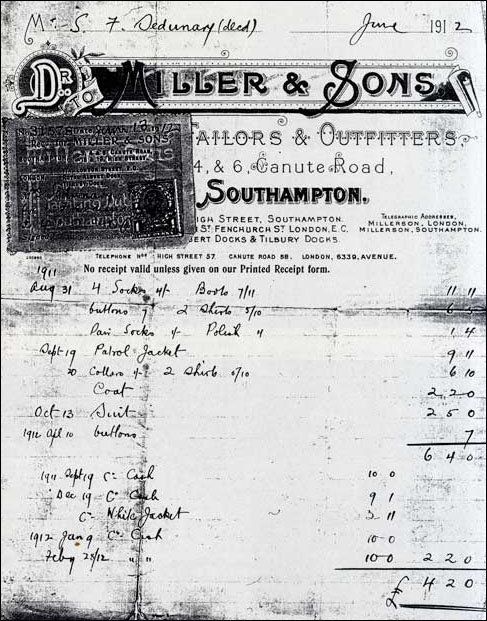
For some companies I didn't stand a chance, but hold on for that explanation. The Southampton companies were pretty choosy, and in any case I preferred Liverpool as a sailing port. You saw other kinds of sailors in Liverpool, but Southampton was just for liners. Deptford in London was my home all the time I was sailing. I saw a lot of Halifax and Montreal on the other side of the Atlantic. But that was over a period of several years. We were in and out of port quite quickly.
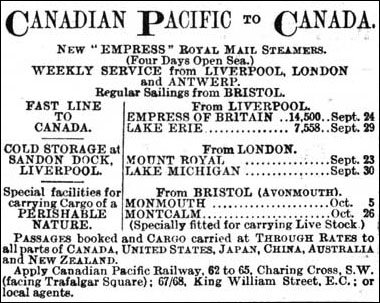
Now, did I tell you that I was first at sea in 1900. Yes, I was 18 then. But does that date mean anything to you? ... the Boer War ... out in South Africa? I joined up to do my bit. And what I learned as a galley boy in the Navy was how important it was to men to have decent grub. A ship's canteen was never the place for cordon bleu efforts. Taught me a few tricks that have come in useful since – need a grater, you know a grater for cheese, punch holes in a large tin can, and it will do the job just fine.
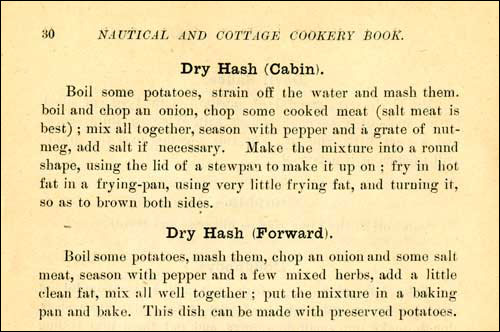
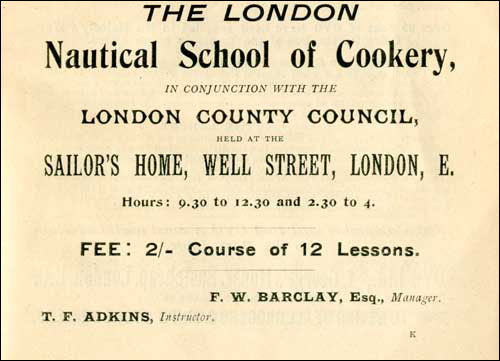
When I chucked the Navy for merchant vessels I decided against being a cook. That's what Dad wanted me to do. He'd seen an advert for a cookery school and said "go get some training, lad". It was more than I wanted to take on. Life could be made pretty unpleasant for a cook on a merchant vessel. What was it they used to say? "God provides the food, and the Devil sends the cook". And you can tell from the Scale of Provisions on the Agreements that the god in question wasn't particularly providential.
I was put under the Chief Steward of the Maryland to be trained and he saw to it that some of my rough edges were smoothed off. When you showed me this "Ship's Steward's Handbook", I was reminded of Eric Carpenter, though I never saw such a guide during my time at sea, only the company rules and regulations.
Now the man I'm talking about was kind enough, but like many who'd worked their way up from being a bell-boy, he gave himself some airs and graces. Nothing against him though, he could smooth over the ruffles of almost any passenger who arrived at his door with complaints against a steward. You'd call them "people skills" now, and some of that he passed on to me.
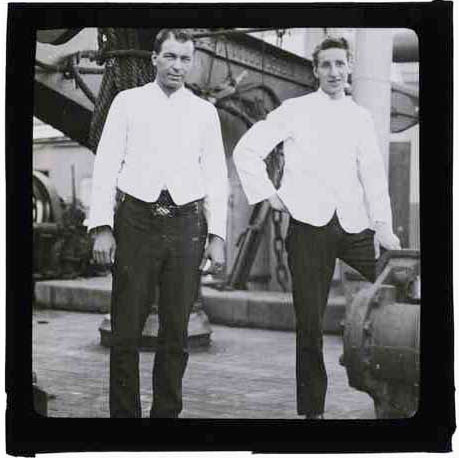
Well it didn't cost much to "oblige" (as the Handbook book says) though sometimes, after a whole day on your feet, the "cheery disposition" it asks for in stewards was hard forced. I was repaid in the tips from grateful passengers, at least when I got to be a first class saloon steward. As a bartender things got even better. But over the long term, did it make up for the low wages the companies paid their stewards? You know, I think not.
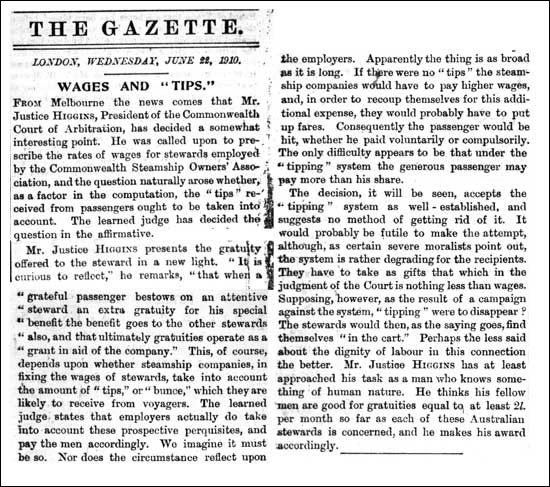
Let me read this out loud from the Handbook, because it will give you an idea of my working day. I can imagine how it would have sounded coming from Chief Steward Carpenter.
The saloon stewards are usually roused at 5:30 a.m., and after having a cup of coffee a start must be made at once to clean out the saloon.
If breakfast is served at 8:30 a.m. all the rough and dirty work of the saloon must be finished by 7:30. Then go and wash and get into uniform ready for preparing the tables for breakfast.
Have a look at the breakfast menu, which should be posted up in the pantry, and then proceed to lay up the tables with necessary table utensils and accessories.
Serving Luncheon. – Commence to lay up the tables for luncheon one hour before the meal is to be served. Always look at the menu first and then proceed to put the requisite utensils and accessories on the table according to the dishes that are to be served.
Afternoon tea, which is generally served at 4 p.m., is quite an informal meal. The table centres, such as sugar, cream, cakes, and biscuits, or bread and butter, should be placed on the tablecloth. The tea cups and saucers and bread plates are arranged round the table opposite each person's seat.
Dinner table preparations must commence to be made one hour before the meal is to be served. This meal is the most elaborate one of the day. It is the meal upon which the chief steward has given his most careful thought, and it is the crowning effort of the day upon the part of the chef. The saloon steward must be at his best, and if, by care of details in table management and good service, he can give pleasure to his passengers the efforts of each department will be crowned with success. An efficient steward will endeavour to anticipate the wants of his passengers, and will pass everything to them in a quiet and orderly manner.
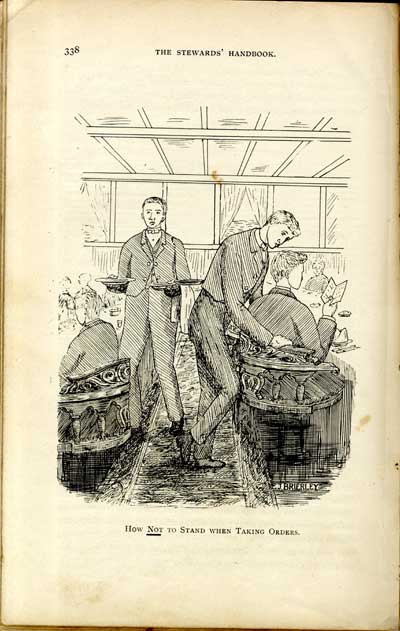
When taking the orders he will stand with heels together and the body slightly inclined forward, so that he will hear at once what the passenger requests and not have to ask him to repeat his order.
When the passengers are being served always keep calm and collected, keep your eyes open to see to the passenger's wants and pass everything to them in a quiet and unostentatious way. When passing to or from the pantry don't rush, just go along quickly and calmly and get what is needed and return quietly.
Remember that, when waiting at table, there are other stewards passing to and fro in the execution of their duties, and the space between tables is not unlimited. When taking an order stand with heels together, not with foot sticking out behind, as another steward may pass at this moment and you are likely to upset him and everything he is carrying; thus spoiling the harmony of the meal, wasting good food, and ruining the carpets.
Above all, keep your hands clean, use a nail-brush, and don't permit the fingers to become stained with cigarette smoke. Personal appearance at table is a valuable asset, and it is essential that the saloon steward shall have a neatly-dressed appearance when serving at table.
Oh yes, personal appearance. I'd been rather proud of my tattoo in the Navy2. But it didn't go down well with the Canadian Pacific and almost certainly it stopped me getting a job with the Southampton liner companies. Even Eric was surprised one day when I was serving at table and an anchor began to appear out from under a crumpled shirt sleeve. "What's that?" he asked later as we were clearing the tables, and you could tell by his tone of voice that he found it unsightly.
"My anchor", I replied, "in case I get set adrift."
"More use than these pepper pots", I added.
Still have one of ‘em, a silver pepper pot, marked "Canadian Pacific", and the tattoo is with me too, though I'm afraid I wouldn't be recognized by the description in the discharge book. Fair hair it says – there's none of that left to me now!
1. The Canadian Pacific Railway commenced an Atlantic steamship service in 1903 after it purchased the Canadian interests of Elder Dempster for nearly £1½ million. In 1915 the company began a merger with the Allan Line and was renamed Canadian Pacific Ocean Steamship Services Limited. Three of the steam liners on which Henry Martin was employed Mount Royal (109498) Montezuma (115252) and Milwaukee (106834) were amongst 14 acquired from Elder Dempster. Mount Royal could carry 1,500 third-class passengers and Montezuma, over 2,000. The Admiralty purchased both of these vessels early in World War I. Martin was second steward in the Milwaukee in 1915, but he left that vessel in October and until 1919 nothing further is recorded in his Discharge Book, most probably because he was on trooping or convoy service (Bonsor 1975).
Back
2. Tattoos were commonly noted on seafarers’ register tickets, but once those were abandoned, in 1857, seafarers moved between vessels and voyages without an identity document that made reference to physical appearance. With the Continuous Discharge Book, introduced in 1900, the physical description was reinstated and soon after photographic imaging was used, though not for Discharge Books, but for the so-called "Seamen's Pouches" (BT 372, TNA). These were kept by the RGSS. The attempt at resurrecting a permanent register of seafarers, after nearly sixty years, was possibly connected with the increase of non-British seafarers. As for the Crew Agreements and the tokens of personal identification provided, photographs occasionally survive from Chinese crew. Their signatures in any case required translation for their English-speaking employers. This points to increased attempts at surveillance.
Back
References
Adkins, Thomas Francis. Alphabetical Guide to Sailors' Cookery for the use of Stewards and Cooks on Cargo-Carrying Vessels (London: Thomas Francis Adkins, 1903).
Bond, Richard. The Ship's Steward's Handbook: A Complete Guide to the Victualling and Catering Departments on Board Ship (Glasgow: James Munro, 1918), pp. 231-338.
Bonsor, N. R. P. North Atlantic Seaway: An Illustrated History of the Passenger Services Linking the Old World with the New in Four Volumes. Vol. 3 (Newton Abbot [Eng.]: David & Charles, 1975), pp. 1282-1289.
Hyslop, Donald, Alastair Forsyth, and Sheila Jemima. Titanic Voices: Memories from the Fateful Voyage (New York: St. Martin's Griffin, 1999).
